Change Your Thoughts…. Change Your Run

I’m sure Kim and Zenaida will be astonished that I’m actually participating in their Tuesday Topics WITH THE CORRECT TOPIC. The prompt was “It’s Positive Thinking Day. What quotes or affirmations do you use to get through a hard run?” This is such a fascinating topic- how much of running is physical, and how much is mental? Mind Over Matter? The Central Governor Theory Explained explores Tim Noakes’ premise that the brain acts as a central governor during exercise, limiting our ability to push beyond perceived fatigue to ensure self-preservation. The central governor gathers data from different sources, including the present effort level, previous training and race experiences, current conditions (i.e. heat, humidity, wind) and the race distance and intensity- then uses this information to set limits on the body. The idea behind this is that the central governor will override your physical ability to run and shut the body down before you’re able to do damage to yourself. However, in the interest of self-preservation, it’s usually operating with an overabundance of caution. People who participate in ultramarathons and other extreme sports have found that when your brain is telling you you’re done, you’re actually only about 40% done. Finding ways to overcome the central governor is key for peak performance. Our thoughts are incredibly powerful. If your thought is “It’s way too hot and I feel crummy” then your brain doesn’t waste time trying to decide if this is true- it just adds it to the data it’s collecting. “It’s 85 degrees, halfway through the run, muscle fatigue is at xxx level, it’s way too hot and I feel crummy” is going to lead to a very different outcome than “It’s 85 degrees, halfway through the run, muscle fatigue is at xxx level, the sun gives me energy and I’m built for this.” Since we can choose what to think, it only makes sense to send positive data to the central governor rather than negative. One of my favorite mantra is “I am strong, I am good at this, I can do it.” If I’m having a difficult run, I’ll commit to saying this over and over for an entire mile. Just like meditation, my mind will wander but I just bring it back to “I am strong, I am good at this, I can do it.” At the end of the mile, I always feel much better- I’ve never had this not work. If I’m nearing the end of a race or speed workout and want something shorter, I use “light and quick” or “fast and strong” (I like my short mantras to be in beats of three!) Often I’ll alternate the two, using one to get a certain distance, and then switching to the other one. Sometimes I just need to keep my mind occupied in this way to prevent the negative thoughts from creeping in. I love hearing other people’s mantras, but the best mantras are the ones we have a personal connection with. My “I am strong…” mantra came from my favorite spin teacher, years ago. In a particularly difficult moment of a particularly difficult class, she said “You are strong! You are good at this! You can do it!” Those words carried me through that class and have stuck with me to this day. Do you use mantras? What is your favorite?
Weekly Rundown- It’s Not a Safety Issue

Before we get to the weekly rundown, let’s talk about Eliza Fletcher. In this episode of the Running Rogue podcast, Chris McClung had some powerful words. He said this is not a safety issue, but a misogyny and violence issue. We shouldn’t have to carry weapons and modify our already busy schedules to go for a run. I know we’re all sickened by what happened to Eliza- and angry that this is the world we live in. While my thoughts are with Eliza’s family and everyone affected by this tragedy, I don’t want this post to be a downer so I’ll move on. My car is still in the shop- but there’s hope! The parts have arrived and they said it would be ready “next week.” In the meantime, my husband has discovered that he actually likes riding his bike to work, and one day even chose to ride carrying his suit in a bag to change into later on. So we’re coping… but I’ll be happy to get that car back! Thanks as always to Kim and Deborah for hosting the weekly rundown. Let’s get into it… finally. Sunday Long(er) run of 6 miles! For all my runs this week, I used intervals of 4 minutes running/30 seconds walking. I’m experimenting with this method, and with this incessant Florida heat and my achy hamstring (will it ever go away???) I’m liking it. Monday Arg! Hamstring is just so achy. I wanted some movement, but nothing too strenuous so I did Marcia’s Cardio Barre Workout. I have done this workout many times now! It’s lower body body and core, and just what I needed to get my legs moving but not stress them too much. I also did an arms and shoulders workout (all workouts other than Marcia’s were on Peloton.) Tuesday Okay, legs felt better. I did one of Matty’s 30 minute glutes and legs workouts, and a short core class. Later in the day I had to attend a band parent meeting, so, since my husband had the car, I rode my bike to my daughter’s school and back. I’m enjoying these bike rides. Oh, and the meeting was about fundraising. Great- I can’t wait to start harassing my coworkers about buying cheesecakes again! SIGH. Wednesday Since I knew I would stay up late on Saturday night for the Baylor game, I decided to make this my longest run of the week. I don’t work on Wednesdays, but I still had to take my daughter to school. After I dropped her off I went to Yamato Scrub Natural Area, where I had a very hot and sandy trail run. I wrote more about this adventure here. I loved exploring the area, but the heat and difficult terrain made it tough. I ran 5 miles and was ready to call it quits, but I was having a little trouble finding my way back to the trail head. I walked for another mile until I found it. Fun morning! Thursday My legs were feeling that sandy run! Once again, I did Marcia’s Cardio Barre Workout. Marcia has a bunch of other classes and I always say I’m going to try them… but then I keep coming back to this one. I followed it with a 20 minute chest and back workout. I haven’t done chest and back in a while, and I was severely punished for my neglect- I was sore from this for a couple days. On a side note, I’ve never been overly interested in the royal family- but the death of Queen Elizabeth jolted my world a little! She’s been queen as long as I’ve been alive- somehow I just assumed she would be there forever. Friday I had a nice 3 mile run, followed by a core class. After all that sand, it felt good to run on pavement again! Saturday Another run- this time just a short 2.5 mile, followed by a glutes and legs workout. I felt like lunges would aggravate my hamstring, so I did Matty’s class from 8/1/21 which is all squats and deadlifts (it’s a companion class to “Lunge-a-Palooza.”) I took a long nap after work because I knew I would being stay up for the Baylor game! They’re in Utah with a late start time. Go Bears! Sunday On tap for today…. rest. I always think I’ll enjoy a rest day, but then end up feeling groggy and awful. So we’ll see- maybe I’ll sneak in a little core class or something. Moving forward, I’ve decided to shift my running schedule around. I’m going to try running M-W-F-Saturday, with my long run being on Wednesday. My days off from work are Wednesday and Sunday, and when I do a long run on Sunday morning I always feel pressured to get back home, like I should be spending time with my family (and waffles, obviously.) Now that school has started, I have Wednesdays to myself. We’ll see how this works out. I hope everyone had a great week! Do you carry a weapon when you run? – I don’t, but I guess I should. I’m open to recommendations! Have you ever taken a self defense class? Once again, I haven’t- but am thinking I should.
More Trail Adventures!

I recently listened to this episode of the Florida Trail Runners podcast. The guest was Brenda Baader-Lips, who completed The Trident: Ridge to Nowhere– a 40 mile race which takes place here in Florida in July… and the best part is, the surface is almost all sugar sand (ack!!!). Brenda said that she prepared for the race by running on the trails in Yamato Scrub Natural Area in Boca Raton. Hey! I know that place! According to Florida Hikes, “A 217-acre natural area atop the Atlantic Coastal Ridge in Boca Raton, Yamato Scrub protects the largest chunk of native scrub habitat found this far south in Florida.” My kids and I went for a hike there years ago, and it’s about a twenty minute drive from my house. People are running on this trail? I must check it out! I had the opportunity to go on Wednesday, although unfortunately a little later than I would have liked. I dropped my daughter off at school and headed over. By the time I got there and was ready to run, it was almost 10 am… not ideal for a hot Florida day. But looking on the bright side, I had plenty of time to explore the area. As I was studying the map at the trail head, an enthusiastic older gentleman came up and offered to “help.” His best piece of advice was that part of the trail was closed for construction (or maintenance? It wasn’t really clear) but other than that he kept telling me what I would be experiencing. “It’s a hidden gem!” he exclaimed repeatedly. Okay, okay! Let me go see this hidden gem for myself! As promised, a significant part of the trail was sugar sand. Did you know that’s very hard to run on? Ha ha… just kidding. Everyone knows that! The outer loop was sugar sand, and there were inner trails that were packed dirt- which SOUNDS easier, but these trails were treacherous. There were a lot of exposed roots, and inevitably at one point I went down. No injuries, but I got up covered in dirt. Because I was so sweaty, the dirt clung to me for the rest of the run. I encountered two other runners out there. One was a man who warned me that part of the trail was closed (yes, I know!) Later another man and I passed each other on one of the sandy sections (he was coming the other way) and he said “This trail sucks!” In spite of the difficulties, I couldn’t agree that it “sucked” so I merely said “Yeah, it’s hard!” But as he ran in the other direction, I had to take a picture… let’s just look at what he was wearing. It was 90 degrees, and the trail was in the direct sun about 90% of the time. I can’t even fathom what he might have been thinking, dressed like that. I wanted to help him out. “Hey Mister! The trail doesn’t suck. It’s your wardrobe choices that need adjustment!” Ultimately, it didn’t matter to me that part of the trail was closed, because I got thoroughly lost on the parts that I ran. The heat and the sand had me exhausted and ready to stop after five miles… but I didn’t know where I was. So I ended up walking one more mile until I used a combination of a little skill and a LOT of luck to stumble upon the entrance to the trail. I was hot, tired and incredibly dirty… but I loved it. I will be back! I’m intrigued by this area and network of trails, and I would like to run it more until I can do it without getting lost. And I would love to do it when it’s 60 degrees instead of 90, but at this time of year I’ll take what I can get! I’m linking up with My First 5K and More, Running With Attitude, Run Laugh Eat Pie, Runs with Pugs, and Zenaida for Fit Five Friday. Thanks, ladies! Do you have any “hidden gems” in your area?
The Run Walk Run Method (aka “Jeffing”)
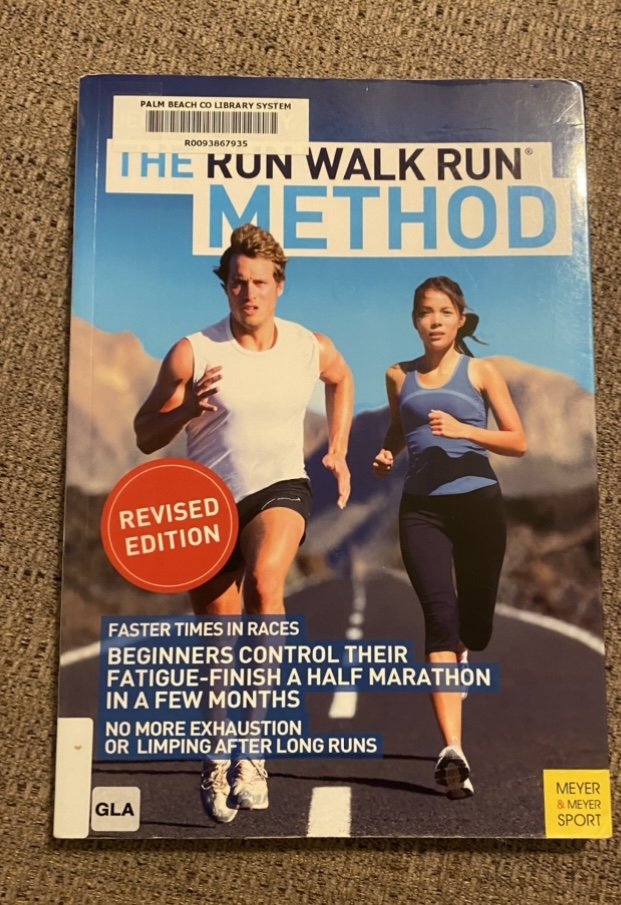
I recently read Jeff Galloway’s book. The Run Walk Run Method. “Run Walk Run” is Jeff’s trademarked term for his method of run/walk intervals, but to make it easier I’ll refer to it as RWR, or as Liz calls it, “jeffing,” ha ha. I’ve been trying out the RWR method for the last couple of weeks- when I’ve been doing it longer I’ll do a post on how it’s working for me. This is mostly a review of the book. I have a couple negatives which I’m just going to get out of the way. The first is, I felt this book was mostly geared towards beginners. There’s all sorts of statements like “become a runner without beginner’s aches and pains,” and “motivates beginners to get off the couch and run.” Even the testimonials at the end are full of “I started running again using your method after twenty sedentary years!” I have NO DOUBT that this method is great for beginners, sedentary people, people who are very overweight or recovering from cancer or open heart surgery; but I’m coming to it from a different perspective. I’m fighting my personal bias that tells me this is a “downgrade” for me, and I wanted evidence that isn’t true. I would have liked more details of Galloway’s own story- he was an Olympic runner before switching to a run/walk method. I’m sure there are plenty of other stories like that, and I wish the book was more focused on that angle. The other negative is probably coming, again, from my personal bias. The whole time I was reading I felt slightly defensive, and it was only afterwards that I figured out why. You know how, as runners, we’re constantly being told that “running is bad for you?” So annoying! In a way I felt like this book was taking that stance. Galloway is basically saying “Running is bad for you (unless you do my Run Walk Run method.)” I know- that’s an exaggeration. He doesn’t actually SAY that. But he is saying that run-walk intervals are better than straight running, which made me want to argue with him. HOWEVER! Let’s just imagine how that argument would go. Me: “I don’t agree with you that continuous running is bad for you!” Jeff: “Oh really? How has that been working out for you lately?” Me: “Er… fine. I’ll try your method.” And that’s basically where I’m at. So now let’s talk about the good things in this book. Among the benefits of RWR (according to Jeff) are fewer injuries, less fatigue at the end of long runs and races, improved race times (in some cases) and a few points I didn’t expect. One thing he recommends is…. running through injuries. NOW we’re on the same page! Of course, with a caveat. You can’t do it with every injury. But the rule of thumb would be, if you can walk, then you can do RWR intervals, even if you’re just starting with 5 seconds running/55 seconds walking. Coincidentally, even before I even read this book, that’s exactly what I was doing with my current hamstring issue. I just couldn’t stand the thought of getting back in the pool, so I went out determined to cover a three mile route however I could. At first I was only running for about ten or twenty steps before I had to walk, but I finished three miles like that. Each time I went out I ran more and walked less, until I got to the point I’m at now (more about that in a bit.) Galloway would say that the physical benefits of doing this include increased blood flow to the injured area, which speeds healing. But the mental benefits are even bigger. Instead of feeling helpless and depressed in the face of an injury, you can take control of the situation. Even if you end up walking the entire time, fine- next time you can insert some short running intervals. If you’ve made progress but the injury starts to hurt again, no problem. You can choose to adjust your run/walk intervals accordingly. I can personally attest that it worked for me, and this was my favorite chapter of the book. Another benefit- according to Galloway- of RWR is the way your body uses endorphins. Galloway claims that RWR intervals lessen the fatigue and irritation to your body, so endorphins that would normally be used to kill pain can now go to boosting your mood, which means you’ll feel even better after a RWR session that you would from continuous running. I can’t say I’ve noticed that- I get a huge boost of endorphins both ways- but I thought it was an interesting point. So, now for the actual RWR intervals. Surprisingly, Galloway says that runners have found they have just as much recovery from a 20-30 second walk break as from a longer walk. In a 60 second walk break, there can be a significant slowdown in the second half, and it can be harder to start running again. He likes shorter running and walking intervals. For example, if a runner is doing 4 minutes running/1 minute walking, he would recommend instead doing 2 minutes running/30 seconds walking. Here’s the pace chart from the book: In case you don’t know your mile pace, there’s an entire chapter dedicated to the “magic mile,” explaining in detail how to do a mile time trial. (Again, I felt this was geared towards beginners.) If you go online, you can find some different RWR pace calculators, like this one: This chart obviously shows longer walking breaks. I think you can just experiment to see what works best for you. Although I’m not running an 8 minute mile pace, I am doing the RWR interval of 4 minutes running/30 seconds walking. I really don’t want to run any less than that, and I also like the short 30 second walk break. But I might experiment with different intervals in the future, just for